Price gamesThe Guessovo journal
Higher or lower: a practical price-game strategy
Compare the exact product, pack size and store before choosing pricier or cheaper. Includes worked Higher or lower examples and Guessovo checkpoint rules.
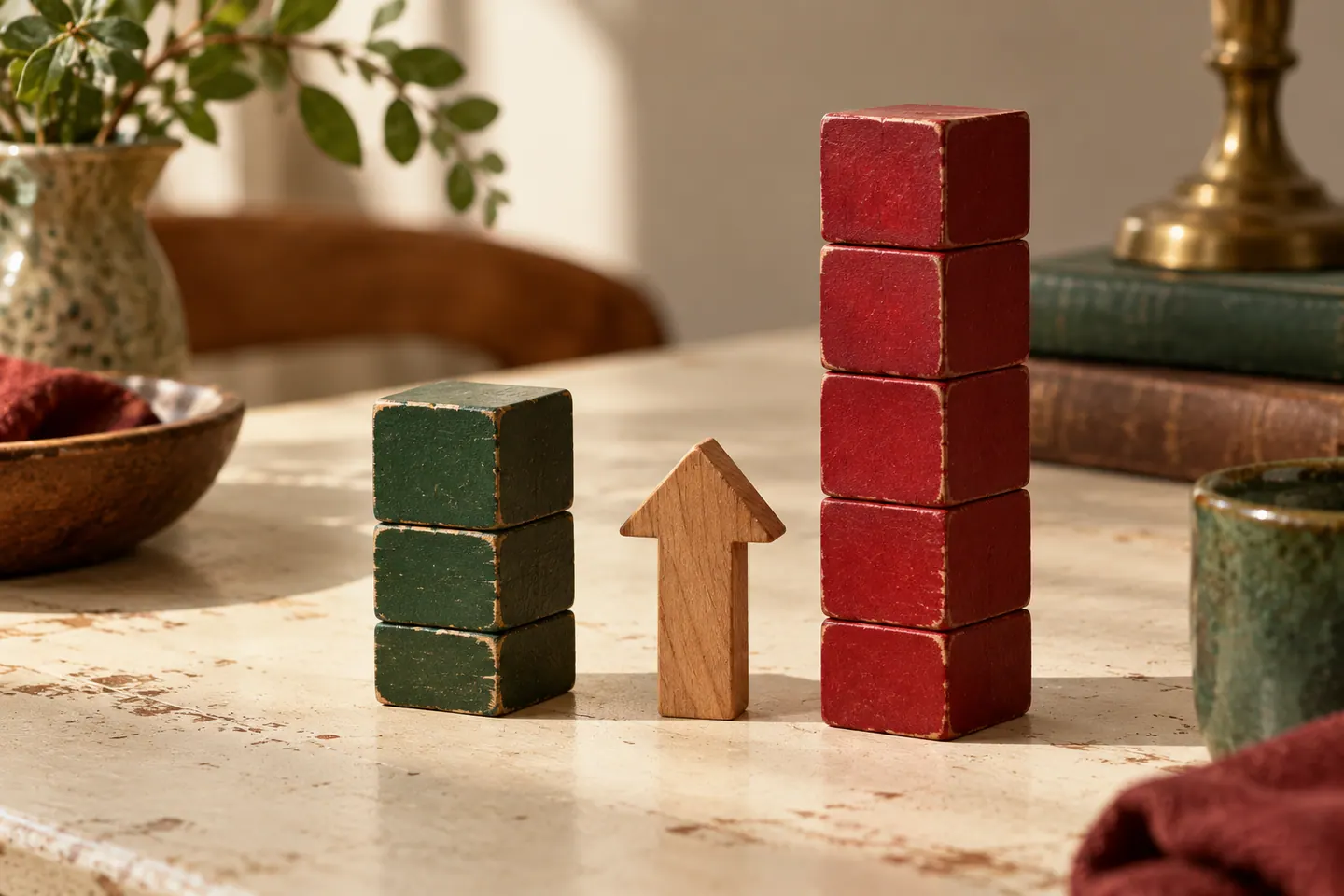
A Higher or lower price game asks a small question: does the next product cost more or less than the price already shown? A useful strategy is to identify the offer, make a rough range, then compare that range with the visible reference. You do not need a perfect amount to make a considered choice.
Start with the shown reference price
Read the amount and currency of the current product before studying the challenger. Your task is a comparison with that one amount, not a search for whether either product is generally expensive. A 40-unit product can be the cheaper choice against 90 and the pricier choice against 15.
Keep the two descriptions separate. The reference may be a set, a refill or a particular model. The challenger may be one small accessory. Comparing only the photographs or brand names can make the question seem closer than the actual offers are. The worked examples here use imaginary products and prices so they can explain the reasoning without suggesting live deals.
Check quantity, variant and construction in that order
First decide what is included. One plate and six plates are different purchases even if a photograph shows a table setting. Next identify the variant: a mini bottle, a large refill and a gift set should not inherit the same estimate just because their labels match.
Then look at details that might move the amount: capacity, materials, lining, included accessories or a different model generation. A familiar brand is one clue, but it cannot tell you that every item in its range is dearer than every item from another brand. If you cannot identify the detail, keep that uncertainty rather than inventing a specification from the picture.
- Quantity: one item, a pair, a set or a multipack?
- Variant: which capacity, size, model or format?
- Construction: which stated materials and included parts?
- Context: which store, country, currency and observation date?
Use a range to make the comparison clearer
Imagine the reference is 50. If the challenger appears to be a small accessory you would place around 10–25, your entire rough range is below the reference. If it is a larger item you would place around 80–120, your range is above it. Those are clearer comparisons than a challenger you would place around 40–70.
When the range straddles the shown price, identify the missing detail that matters most. Is it a single piece or a set? Is the capacity twice what you first thought? This is a reasoning routine, not a measured probability model. The width or position of your range does not produce a certified confidence percentage.
In the notebook
Where does your range sit?
Shown price 50
Illustrative estimates against a shown price of 50. A range that crosses 50 leaves the comparison uncertain; check the product details again.
| Your estimated challenger range | What the range suggests |
|---|---|
| 10–25 | Entire range is cheaper |
| 40–70 | Range crosses the reference; revisit the details |
| 80–120 | Entire range is pricier |
Do not turn a recent result into a rule
One unexpectedly cheap shoe does not establish that every shoe in the next round will be cheap. A sequence of pricier answers also does not, by itself, establish that a cheaper answer is due. Inspect the new product rather than using the last few arrows as evidence about its price.
Price endings are another weak shortcut. A .99 amount can be above or below the reference, and it does not establish a discount. Our catalogue-ending study describes collected listing rows; it does not validate a strategy for predicting the next selected game item.
Likewise, a larger photograph does not imply a larger product. Use stated dimensions and quantities where available. If a product really looks unclear or its photo seems wrong, use the report option rather than assuming the ambiguity is a clever hint.
Make the call, then inspect the reveal
In Guessovo, choose Pricier or Cheaper; the up and down arrow keys are also supported. A correct comparison continues the run and earns XP. Every tenth correct call is a checkpoint where you can bank the run or continue. These are the game's current rules, not advice to keep playing beyond a stopping point you chose.
After a reveal, compare the recorded amount with the range you had in mind. If the outcome surprised you, find one detail that changes your estimate. You can learn more from recognising a missed pack size than from remembering an isolated number that may change at the retailer tomorrow.
When you want to test the amount itself, switch to price guessing or a focused Practice round. Higher or lower and amount guessing ask related but different questions. Neither a winning run nor one close guess measures your general shopping ability, and there is no guaranteed winning method in this guide.
A little time well spent
Put it into practice.
Stay curious
Another page to turn.

How to get better at price-guessing games
Learn to estimate product prices using size, materials, store context and a simple review routine. Includes worked examples and Guessovo practice tips.
Percentage error in price guesses: formula and examples
Calculate how far a price guess is over or under the answer. Worked examples explain the correct denominator, equal misses and Guessovo's score bands.
How to host a price-guessing game with family and friends
Run a family price-guessing game with one phone: secret guesses, fair rules and a shared reveal. Includes a five-round plan and Guessovo Family mode.