Shopping basicsThe Guessovo journal
Shrinkflation: how to compare changing pack sizes
A smaller pack can hide a higher unit price. Learn the calculation with original examples, a comparison checklist and links to NIST and BLS explanations.
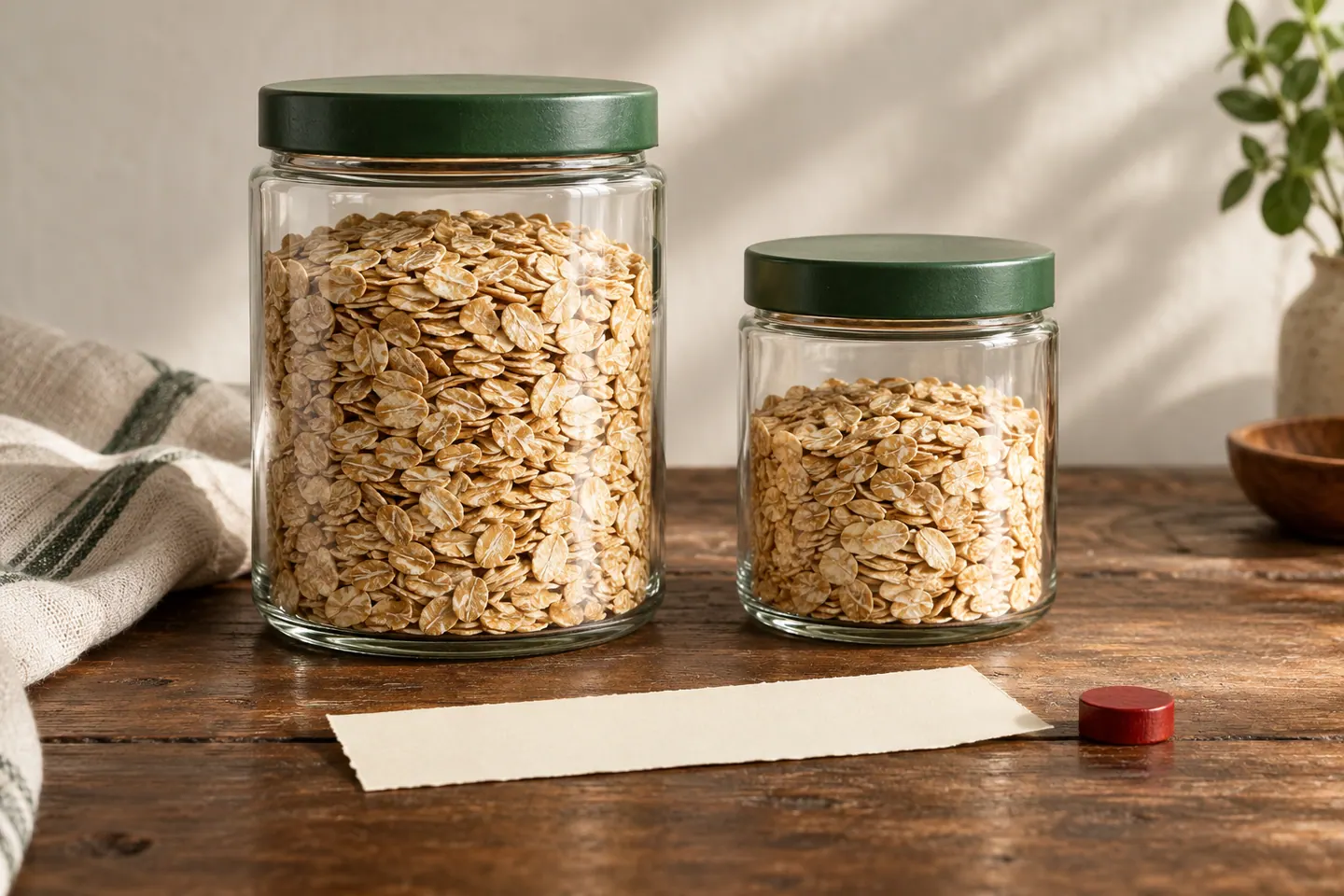
If a pack gets smaller while its price stays the same, you pay more for each gram, millilitre or item. Comparing the old and new unit prices makes the change visible. You need two genuinely comparable observations before calling a particular product an example of shrinkflation.
What changes when the sticker price stays still
Shrinkflation commonly describes a reduction in a product's contents without a matching price reduction. The National Institute of Standards and Technology explains why comparing price per unit can reveal that change. A similar-looking container is not a reliable measure of what is inside: use the stated net quantity.
Imagine an old pack contains 500 g and costs 5. Its unit price is 1 per 100 g. A new pack costs the same 5 but contains 450 g, making its unit price about 1.11 per 100 g. The checkout amount is unchanged, while the quantity you receive for that amount has fallen. These are hypothetical packs, not an allegation about a real brand.
A 10% smaller pack creates an 11.1% unit-price increase
The reduction from 500 g to 450 g is 50 ÷ 500 × 100 = 10%. But the unit-price increase uses a different base: (5 ÷ 450) ÷ (5 ÷ 500) − 1 = 0.1111…, or about 11.1%. The percentage quantity loss and percentage unit-price rise are not equal.
For an unchanged pack price, you can calculate the unit-price increase directly as old quantity ÷ new quantity − 1. Multiply by 100 to express it as a percentage. Use full precision until the end; rounding each unit price first can hide small differences or slightly distort the result.
In the notebook
Same price. Less inside.
1.00per 100 g
1.111…per 100 g
Hypothetical packs, both costing 5 currency units. Reducing 500 g to 450 g makes the price per 100 g about 11.1% higher. Drawings are illustrative.
| Pack | Contents | Price per 100 g | Change from 500 g pack |
|---|---|---|---|
| Original | 500 g | 1.00 | Reference |
| Smaller | 450 g | 1.111… | +11.1% per 100 g |
| Smaller again | 400 g | 1.25 | +25% per 100 g |
When the price changes too, calculate both unit prices
If the smaller 450 g pack costs 4.50 instead of 5, it remains 1 per 100 g: the 10% price reduction matches the 10% quantity reduction. If it costs 4.80, the unit price is about 1.067 per 100 g, or 6.7% higher than the original pack despite a lower sticker price.
Use this general formula: ((new price ÷ new quantity) ÷ (old price ÷ old quantity) − 1) × 100. Prices must be in the same currency and quantities in the same unit. For a multipack, use its total contents: four 90 g packets contain 360 g, not 90 g.
Check that the old and new observations really match
A photo of a small pack next to a large pack is not enough. They may be different formats sold at the same time, different markets or different product concentrations. To document a change, match the brand, product type, formulation where known, market and comparable selling conditions, then record the two dates.
Keep the old receipt or dated listing alongside a clear record of net quantity. A previous temporary sale should not silently become the regular-price baseline. If you cannot establish that one comparable offer replaced another, describe the difference between the two packs rather than asserting a historical reduction.
For paper goods, detergent and concentrates, weight or volume may not capture equivalent use. Sheet size, ply, dilution instructions or the number of stated doses can matter. Keep those specifications visible; price per gram alone does not establish that two products perform the same job.
- Record the old and new prices, quantities and dates.
- Convert the quantities to one shared measurement.
- Check variants, formulation, pack count and promotional conditions.
- Compare unit prices without rounding early.
- Separate a documented pack change from two different products.
A pack comparison is not an inflation estimate
The US Bureau of Labor Statistics explains how its Consumer Price Index handles product-size changes. That is a statistical process across a defined collection of goods and services. Finding a smaller pack in one store does not measure the inflation rate for a category, country or household.
Guessovo's catalogue is also a collection of dated store listings, not a representative retail price index. One current game offer cannot establish that a pack shrank. Use the catalogue to practise noticing quantities, and use matched historical evidence if you want to investigate an actual size change.
A short routine for your next comparison
Before choosing between packs, look at the quantity before the shape of the box. Read the shelf unit-price label if the units match; otherwise calculate it. Then consider the total you need to spend and the amount you will actually use. A larger pack with a lower unit price is not automatically the right purchase for you.
In a price-guessing round, enter the full price of the named pack rather than its calculated unit price. After the reveal, check whether missing the size or pack count explains the gap. That is a concrete detail to carry into the next round, without treating a game result as evidence about a manufacturer's history.
A little time well spent
Put it into practice.
Stay curious
Another page to turn.
Unit price vs sticker price: compare the real value
Compare pack sizes with price per gram, litre or item. Worked examples explain unit pricing, multibuys and when a larger pack is not better value.
How to compare sale prices beyond the discount badge
Work out sale prices, combined discounts and delivered totals. Original examples show why the biggest percentage discount is not always the cheaper offer.

Percentage error in price guesses: formula and examples
Calculate how far a price guess is over or under the answer. Worked examples explain the correct denominator, equal misses and Guessovo's score bands.